
OTD 34 years ago, I warned: “Pandering to protectionists is poisoning the North American Free Trade Agreement.” NAFTA’s managed trade squabbles sowed the seeds for future trade wars. Trump vindicated this article.
Wall Street Journal, July 31, 1992: “Free trade is not complex; it does not require an army of bureaucrats to define and re-define it. It is protectionism that requires endless administrative gimmicks to camouflage its true nature. With each new politically contrived definition of fair trade, the NAFTA negotiators are sowing the seeds of future uncertainty, accusations and ill will.”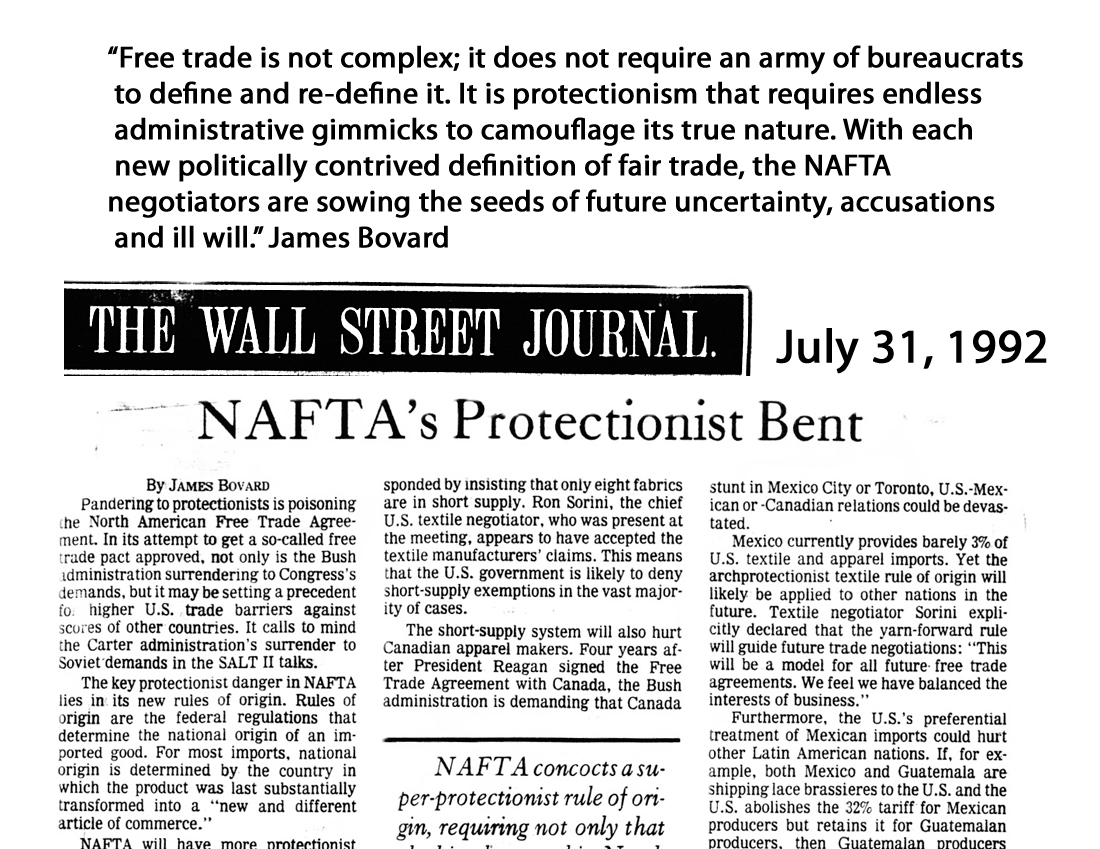
The Wall Street Journal
Copyright (c) 1992, Dow Jones & Co., Inc.
Friday, July 31, 1992
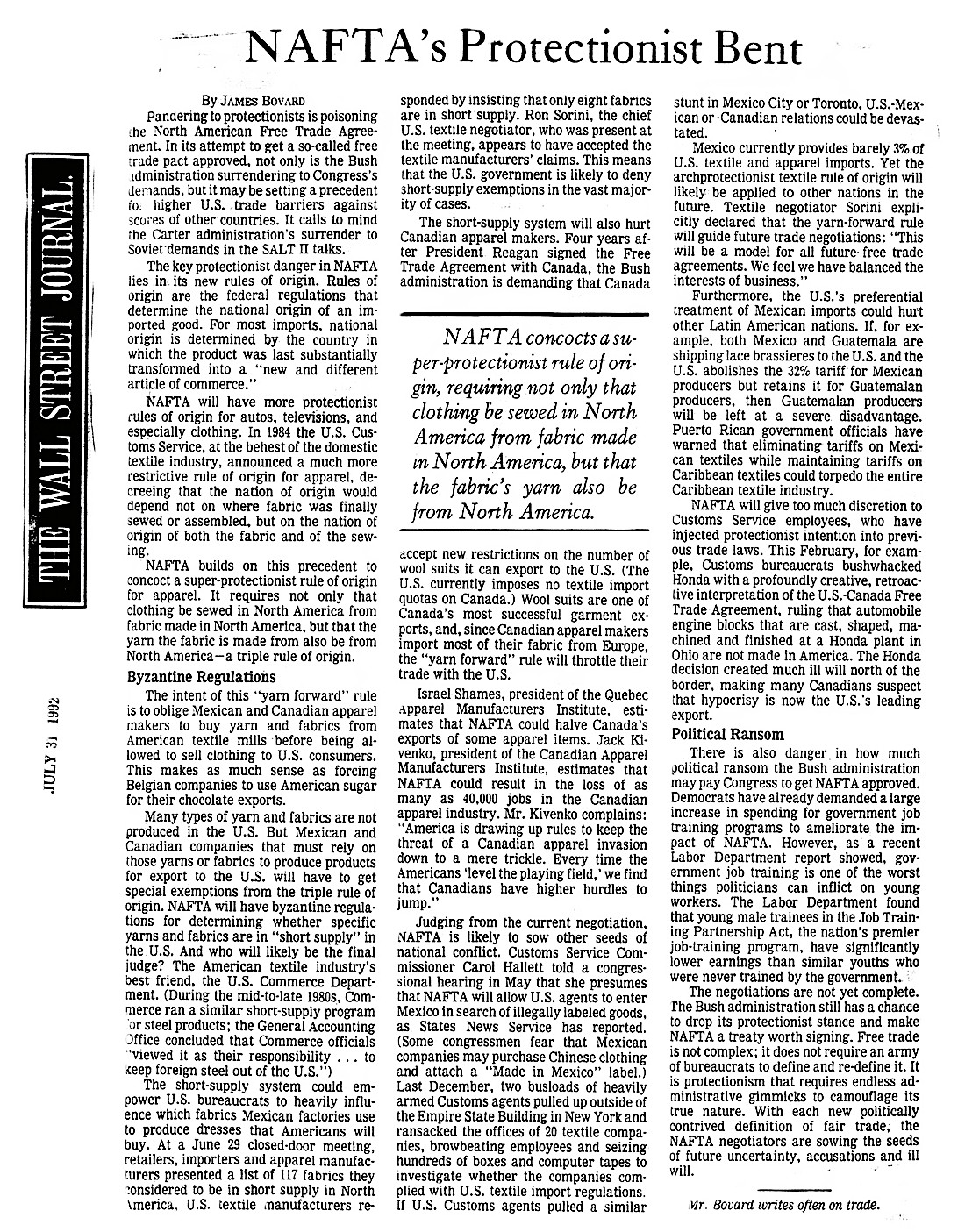
NAFTA’s Protectionist Bent
By James Bovard
Pandering to protectionists is poisoning the North American Free
Trade Agreement. In its attempt to get a so-called free trade pact
approved, not only is the Bush administration surrendering to
Congress’s demands, but it may be setting a precedent for higher
U.S. trade barriers against scores of other countries. It calls to
mind the Carter administration’s surrender to Soviet demands in the
SALT II talks.
The key protectionist danger in NAFTA lies in its new rules of
origin. Rules of origin are the federal regulations that determine
the national origin of an imported good. For most imports, national
origin is determined by the country in which the product was last
substantially transformed into a “new and different article of
commerce.”
NAFTA will have more protectionist rules of origin for autos,
televisions, and especially clothing. In 1984 the U.S. Customs
Service, at the behest of the domestic textile industry, announced a
much more restrictive rule of origin for apparel, decreeing that the
nation of origin would depend not on where fabric was finally sewed
or assembled, but on the nation of origin of both the fabric and of
the sewing.
NAFTA builds on this precedent to concoct a super-protectionist
rule of origin for apparel. It requires not only that clothing be
sewed in North America from fabric made in North America, but that
the yarn the fabric is made from also be from North America — a
triple rule of origin.
The intent of this “yarn forward” rule is to oblige Mexican and
Canadian apparel makers to buy yarn and fabrics from American
textile mills before being allowed to sell clothing to U.S.
consumers. This makes as much sense as forcing Belgian companies to
use American sugar for their chocolate exports.
Many types of yarn and fabrics are not produced in the U.S. But
Mexican and Canadian companies that must rely on those yarns or
fabrics to produce products for export to the U.S. will have to get
special exemptions from the triple rule of origin. NAFTA will have
byzantine regulations for determining whether specific yarns and
fabrics are in “short supply” in the U.S. And who will likely be the
final judge? The American textile industry’s best friend, the U.S.
Commerce Department. (During the mid-to-late 1980s, Commerce ran a
similar short-supply program for steel products; the General
Accounting Office concluded that Commerce officials “viewed it as
their responsibility . . . to keep foreign steel out of the U.S.”)
The short-supply system could empower U.S. bureaucrats to heavily
influence which fabrics Mexican factories use to produce dresses
that Americans will buy. At a June 29 closed-door meeting,
retailers, importers and apparel manufacturers presented a list of
117 fabrics they considered to be in short supply in North America;
U.S. textile manufacturers responded by insisting that only eight
fabrics are in short supply. Ron Sorini, the chief U.S. textile
negotiator, who was present at the meeting, appears to have accepted
the textile manufacturers’ claims. This means that the U.S.
government is likely to deny short-supply exemptions in the vast
majority of cases.
The short-supply system will also hurt Canadian apparel makers.
Four years after President Reagan signed the Free Trade Agreement
with Canada, the Bush administration is demanding that Canada accept
new restrictions on the number of wool suits it can export to the
U.S. (The U.S. currently imposes no textile import quotas on
Canada.) Wool suits are one of Canada’s most successful garment
exports, and, since Canadian apparel makers import most of their
fabric from Europe, the “yarn forward” rule will throttle their
trade with the U.S.
Israel Shames, president of the Quebec Apparel Manufacturers
Institute, estimates that NAFTA could halve Canada’s exports of some
apparel items. Jack Kivenko, president of the Canadian Apparel
Manufacturers Institute, estimates that NAFTA could result in the
loss of as many as 40,000 jobs in the Canadian apparel industry. Mr.
Kivenko complains: “America is drawing up rules to keep the threat
of a Canadian apparel invasion down to a mere trickle. Every time
the Americans ‘level the playing field,’ we find that Canadians have
higher hurdles to jump.”
Judging from the current negotiation, NAFTA is likely to sow
other seeds of national conflict. Customs Service Commissioner Carol
Hallett told a congressional hearing in May that she presumes that
NAFTA will allow U.S. agents to enter Mexico in search of illegally
labeled goods, as States News Service has reported. (Some
congressmen fear that Mexican companies may purchase Chinese
clothing and attach a “Made in Mexico” label.) Last December, two
busloads of heavily armed Customs agents pulled up outside of the
Empire State Building in New York and ransacked the offices of 20
textile companies, browbeating employees and seizing hundreds of
boxes and computer tapes to investigate whether the companies
complied with U.S. textile import regulations. If U.S. Customs
agents pulled a similar stunt in Mexico City or Toronto,
U.S.-Mexican or -Canadian relations could be devastated.
Mexico currently provides barely 3% of U.S. textile and apparel
imports. Yet the archprotectionist textile rule of origin will
likely be applied to other nations in the future. Textile negotiator
Sorini explicitly declared that the yarn-forward rule will guide
future trade negotiations: “This will be a model for all future free
trade agreements. We feel we have balanced the interests of
business.”
Furthermore, the U.S.’s preferential treatment of Mexican imports
could hurt other Latin American nations. If, for example, both
Mexico and Guatemala are shipping lace brassieres to the U.S. and
the U.S. abolishes the 32% tariff for Mexican producers but retains
it for Guatemalan producers, then Guatemalan producers will be left
at a severe disadvantage. Puerto Rican government officials have
warned that eliminating tariffs on Mexican textiles while
maintaining tariffs on Caribbean textiles could torpedo the entire
Caribbean textile industry.
NAFTA will give too much discretion to Customs Service employees,
who have injected protectionist intention into previous trade laws.
This February, for example, Customs bureaucrats bushwhacked Honda
with a profoundly creative, retroactive interpretation of the
U.S.-Canada Free Trade Agreement, ruling that automobile engine
blocks that are cast, shaped, machined and finished at a Honda plant
in Ohio are not made in America. The Honda decision created much ill
will north of the border, making many Canadians suspect that
hypocrisy is now the U.S.’s leading export.
There is also danger in how much political ransom the Bush
administration may pay Congress to get NAFTA approved. Democrats
have already demanded a large increase in spending for government
job training programs to ameliorate the impact of NAFTA. However, as
a recent Labor Department report showed, government job training is
one of the worst things politicians can inflict on young workers.
The Labor Department found that young male trainees in the Job
Training Partnership Act, the nation’s premier job-training program,
have significantly lower earnings than similar youths who were never
trained by the government.
The negotiations are not yet complete. The Bush administration
still has a chance to drop its protectionist stance and make NAFTA a
treaty worth signing. Free trade is not complex; it does not require
an army of bureaucrats to define and re-define it. It is
protectionism that requires endless administrative gimmicks to
camouflage its true nature. With each new politically contrived
definition of fair trade, the NAFTA negotiators are sowing the seeds
of future uncertainty, accusations and ill will.
—
Mr. Bovard writes often on trade.



No comments yet.