
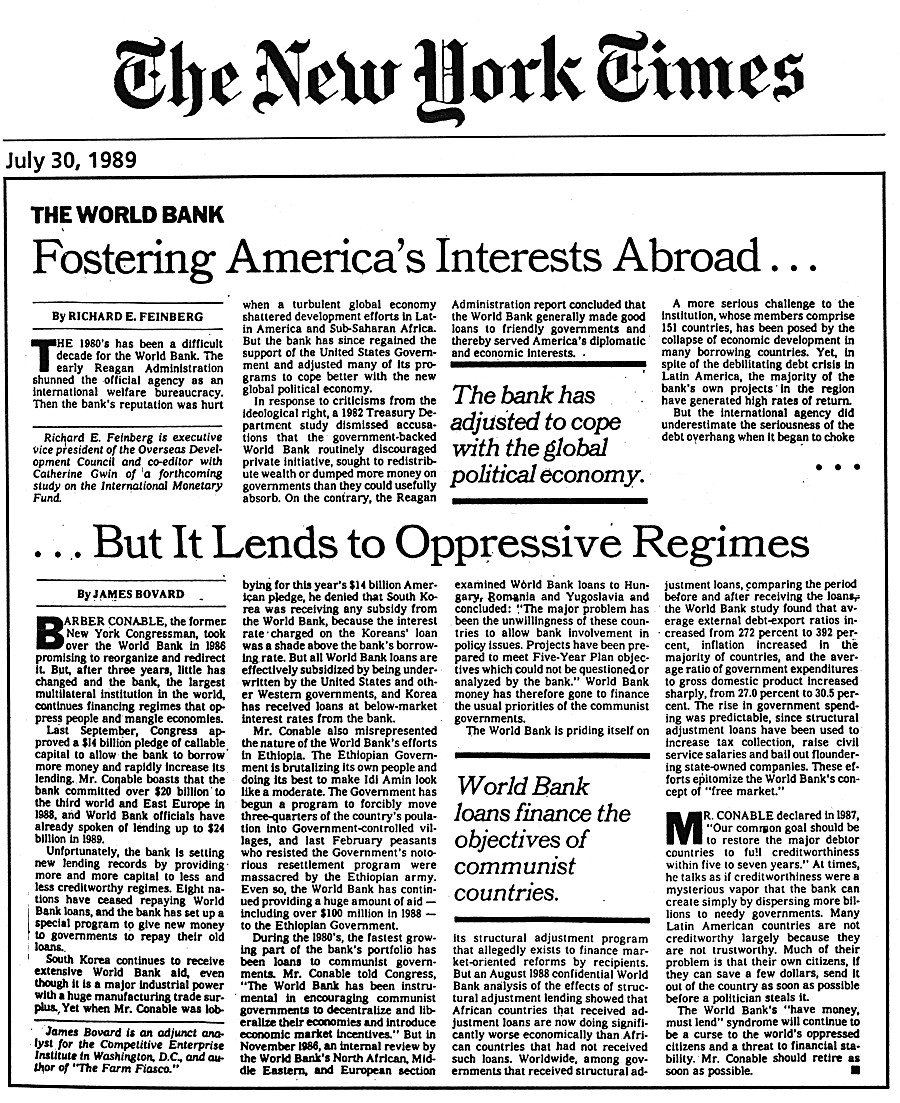
 The New York Times, July 30, 1989,
THE WORLD BANK; Fostering America’s Interests Abroad . . . But It Lends to Oppressive Regimes
BYLINE: By JAMES BOVARD; James Bovard is an adjunct analyst for the Competitive Enterprise Institute in Washington, D.C., and author of ”The Farm Fiasco.”
Barber Conable, the former New York Congressman, took over the World Bank in 1986 promising to reorganize and redirect it. But, after three years, little has changed and the bank, the largest multilateral institution in the world, continues financing regimes that oppress people and mangle economies.
Last September, Congress approved a $4 billion pledge of callable capital to allow the bank to borrow more money and rapidly increase its lending. Mr. Conable boasts that the bank committed over $20 billion to the third world and East Europe in 1988, and World Bank officials have already spoken of lending up to $24 billion in 1989.
Unfortunately, the bank is setting new lending records by providing more and more capital to less and less creditworthy regimes. Eight nations have ceased repaying World Bank loans, and the bank has set up a special program to give new money to governments to repay their old loans.
South Korea continues to receive extensive World Bank aid, even though it is a major industrial power with a huge manufacturing trade surplus. Yet when Mr.
Conable was lobbying for this year’s $14 billion American pledge, he denied that South Korea was receiving any subsidy from the World Bank, because the interest rate charged on the Koreans’ loan was a shade above the bank’s borrowing rate. But all World Bank loans are effectively subsidized by being underwritten by the United States and other Western governments, and Korea has received loans at below-market interest rates from the bank.
Mr. Conable also misrepresented the nature of the World Bank’s efforts in Ethiopia. The Ethiopian Government is brutalizing its own people and doing its best to make Idi Amin look like a moderate. The Government has begun a program to forcibly move three-quarters of the country’s population into Government-controlled villages, and last February peasants who resisted the Government’s notorious resettlement program were massacred by the Ethiopian army. Even so, the World Bank has continued providing a huge amount of aid – including over $100 million in 1988 – to the Ethiopian Government.
During the 1980’s, the fastest growing part of the bank’s portfolio has been loans to communist governments. Mr. Conable told Congress, ”The World Bank has
been instrumental in encouraging communist governments to decentralize and liberalize their economies and introduce economic market incentives.” But in
November l986, an internal review by the World Bank’s North African, Middle Eastern, and European section examined World Bank loans to Hungary, Romania and Yugoslavia and concluded: ”The major problem has been the unwillingness of these countries to allow bank involvement in policy issues. Projects have been
prepared to meet Five-Year Plan objectives which could not be questioned or analyzed by the bank.” World Bank money has therefore gone to finance the usual
priorities of the communist governments.
The World Bank is priding itself on its structural adjustment program that allegedly exists to finance market-oriented reforms by recipients. But an August
1988 confidential World Bank analysis of the effects of structural adjustment lending showed that African countries that received adjustment loans are now
doing significantly worse economically than African countries that had not received such loans. Worldwide, among governments that received structural
adjustment loans, comparing the period before and after receiving the loans, the World Bank study found that average external debt-export ratios increased from
272 percent to 392 percent, inflation increased in the majority of countries, and the average ratio of government expenditures to gross domestic product
increased sharply, from 27.0 percent to 30.5 percent. The rise in government spending was predictable, since structural adjustment loans have been used to
increase tax collection, raise civil service salaries and bail out floundering state-owned companies. These efforts epitomize the World Bank’s concept of
”free market.”
Mr. CONABLE declared in 1987, ”Our common goal should be to restore the major debtor countries to full creditworthiness within five to seven years.” At
times, he talks as if creditworthiness were a mysterious vapor that the bank can create simply by dispersing more billions to needy governments. Many Latin American countries are not creditworthy largely because they are not trustworthy. Much of their problem is that their own citizens, if they can save a few dollars, send it out of the country as soon as possible before a politician steals it.
The World Bank’s ”have money, must lend” syndrome will continue to be a curse to the world’s oppressed citizens and a threat to financial stability. Mr.
Conable should retire as soon as possible.



No comments yet.