
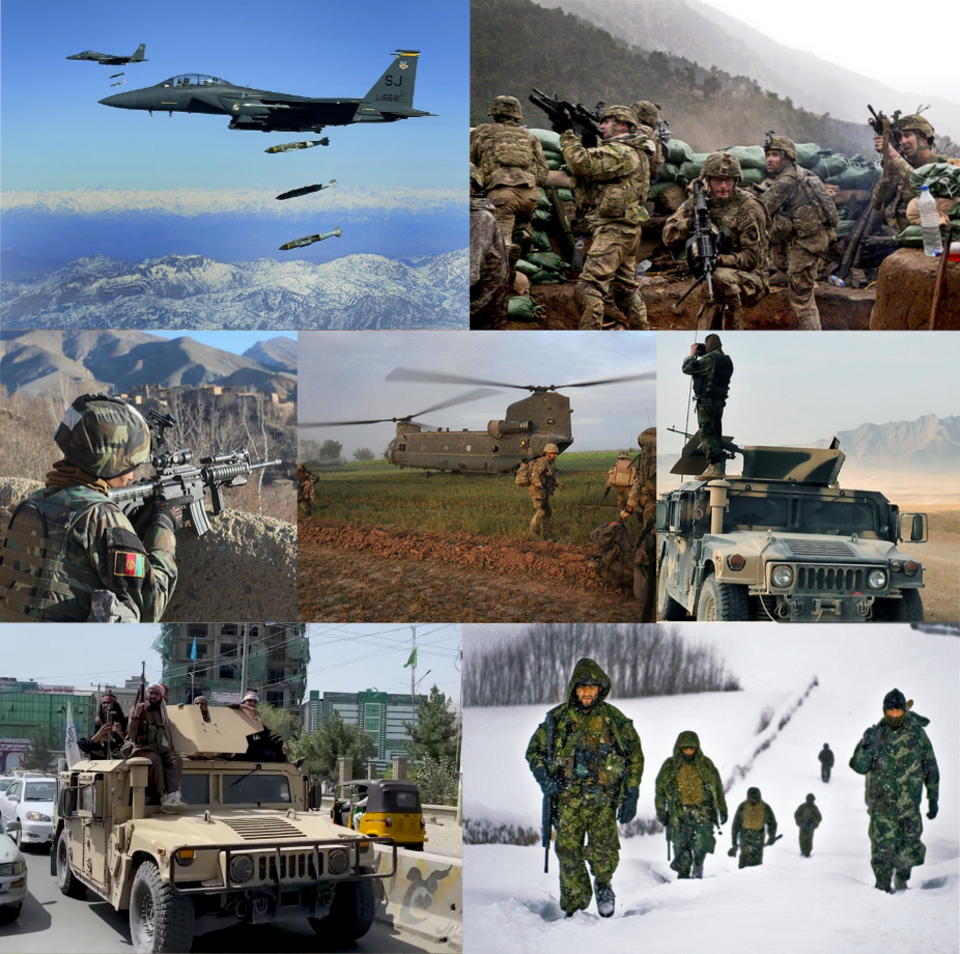
Collage via Wikipedia
Afghan Lessons for American Democracy
by James Bovard
After Al Qaeda terrorists used Afghanistan for training bases for the 9/11 attacks, the U.S. military invaded Afghanistan and quickly routed the Taliban government. President George W. Bush boasted that U.S. troops brought freedom and democracy to Afghanistan. But rather than democracy, the United States brought Hamid Karzai, an oil pipeline lobbyist who was expected to slavishly follow U.S. orders.
“Democracy” under Karzai
Shortly after he was ensconced into power, Karzai pledged to an American audience that fighting corruption would be among his highest goals. An election was held to legitimize his power in 2004, including “get out the vote” drives threatening to burn people’s houses down unless they voted for Karzai. All 15 of the opposing candidates denounced the fraud-ridden election, but that did nothing to deter Bush from taking multiple victory laps for bringing democracy to Afghanistan.
Karzai’s five-year term saw the revival of the Taliban and widespread Afghan disgust at a government permeated by corruption. In , Obama ordered 21,000 additional U.S. troops to Afghanistan to “secure the election” coming up in August. On , 2009, Obama congratulated Afghans on the start of the official election campaign: “Each nation gives life to democracy in its own way, grounded in the traditions of its own people…. That is why we are working with Afghan electoral authorities and the United Nations to help Afghans ensure a credible, secure, and inclusive election process.” But the political campaign became more tawdry than any election in Chicago history. To bolster support from fundamentalist voters, Karzai approved a law entitling a husband to starve his wife to death if she refused his sexual demands.
When Obama spoke to the Veterans of Foreign Wars convention in , he boasted that “our troops are helping to secure polling places for this week’s election so that Afghans can choose the future that they want.” In reality, Obama effectively sent American soldiers to serve as bodyguards for Karzai’s minions to steal the election. Afghanistan’s Electoral Complaints Commission was deluged with thousands of allegations of fraud or abuse. Two weeks after the election, the New York Times reported that Karzai’s operatives set up as many 800 fictitious polling sites “where no one voted but where hundreds of thousands of ballots were still recorded toward the president’s re-election.” In some Afghan provinces, pro-Karzai ballots outnumbered actual voters by tenfold.
A few weeks later, Peter Galbraith, one of the top United Nations officials in Afghanistan, was fired after he publicly estimated that a third of Karzai’s votes were bogus. Galbraith declared, “No amount of spin can obscure the fact that we spent upwards of $200 million on an election that has been a total fiasco.” He lamented that “the fraud has handed the Taliban its greatest strategic victory in eight years of fighting the United States and its Afghan partners.”
Rampant electoral fraud
The United Nations, which helped oversee the election, eventually disqualified a million votes (mostly for Karzai). This meant that Karzai had less than a majority and that Afghan law required a runoff election with the second-place finisher, Abdullah Abdullah. On , Karzai effectively publicly confessed to massive vote fraud and petulantly agreed to a runoff election. Obama rushed to praise Karzai for taking “an important step forward in ensuring a credible process for the Afghan people which results in a government that reflects their will…. It is now vital that all elements of Afghan society continue to come together to advance democracy, peace and justice.”
Having a second round of voting seemed akin to catching a really dumb bank robber in the act — and then, instead of charging him, giving him another chance to rob the same bank. Karzai prepared for the runoff by firing all the members of the Independent Election Board and stacking it with his cronies. Abdullah recognized the second round would be a sham and withdrew from the runoff. The Obama administration responded by redefining success — or at least democracy. White House Press Secretary Robert Gibbs declared: “President Karzai has been declared the winner of the Afghan elections and will head the next government of Afghanistan, and so obviously he is the legitimate leader of the country.” But Saddam Hussein could have invoked the same standard to claim to be the legitimate leader of Iraq, since he won several rigged elections.
A few weeks later, Obama traveled to the U.S. Military Academy at West Point, where he announced plans to send more troops to Afghanistan. Obama boasted, “In Afghanistan, we and our allies prevented the Taliban from stopping a presidential election, and — although it was marred by fraud —that election produced a government that is consistent with Afghanistan’s laws and constitution.” But there was nothing in the Afghan laws entitling incumbents to steal elections.
Sham democracy and corruption
The “democracy” that the U.S. military was bestowing on Afghanistan was always a sham. Shortly after Obama’s West Point speech, Gen. Stanley McChrystal, the U.S. commander in Afghanistan, sent in troops to inflict democracy on a village named Marja in southern Afghanistan. Shortly before the assault began, McChrystal announced: “We’ve got a government in a box, ready to roll in.” In the same way that the U.S. government plopped Karzai into Afghanistan in 2002 as its “democratic” leader, the U.S. military brought in Afghan emigre Abdul Zahir to serve as Marja’s new governor. The Washington Post noted that Zahir was touted as “a respected elder from the Alozai tribe, a landowner who lived in Marja in his youth…. U.S. Marines and civilian advisers in Marja have given him money and protection in an attempt to persuade a wary population to follow him.” Zahir’s accession hit a bump after it leaked out that he had spent four years in prison for attempting to murder his stepson while living in Germany. The Washington Post noted: “U.S. officials in Afghanistan said Zahir’s criminal conviction did not undermine their confidence in his ability to govern.” Zahir never received popular support and was murdered at a local meeting the following year.
The Afghan government continued corrupt and inept. At Afghanistan’s premier military hospital, some wounded Afghan soldiers starved to death because they could not afford to bribe the hospital staff for food. Much of the Afghan army was practically bootless because of crooked contracts that delivered shoddy footwear that fell apart the first time soldiers wore them. The Taliban advanced further with each year of Karzai’s second term.
Self-government in Afghanistan was defined down to the right officials pocketing the right bribes from U.S. government henchmen. In , the New York Times revealed that the CIA had been making secret massive cash payoffs to top Afghan government officials in order to protect them from corruption. The Times explained, “Called ‘top-up raises,’ they had been paid by the American government to keep qualified people and insulate them from corruption and political interference.” As long as the payoff recipients followed U.S. orders, there was apparently no danger of “political interference.” One U.S. government official explained, “The corruption we need to combat is the corruption that undermines the fight against the Taliban.” Thus, as long as the officials who were accepting the secret payoffs appeared to be anti-Taliban, there was no problem. Democracy works in mysterious ways.
The bogus 2014 election
More than 1,500 U.S. soldiers were killed seeking to stabilize Afghanistan between its 2009 and 2014 presidential elections, the latter in which Karzai was term-limited from running in again. But the soldiers’ sacrifice was in vain, at least as far as Afghanistan advancing toward democracy. Eight million ballots were tallied in the 2014 election — far more than election observers had expected. Abdullah Abdullah, who had probably won the 2009 election, won the first round by a large margin. But in the runoff, Ashraf Ghani, a former World Bank official and Karzai’s favorite, came up with a deluge of new votes and was declared the winner.
The Abdullah campaign released recordings of phone calls from the Karzai-appointed chief of the Independent Election Commission coaching local officials on how to fabricate vast numbers of ballots for Ghani. Angry crowds of protestors in Kabul chanted “Death to the Independent Election Commission!” Almost 400,000 votes came from polling stations “that reported that 100 percent of the votes went just one way.” The New York Times noted of the election dispute: “After years of Western aid spent building it, the Afghan state is suddenly at risk of collapsing just as American troops are leaving.”
The U.S. government again gave its blessings to a sham election. Despite “serious allegations of extensive fraud,” the State Department decreed that “the final outcome of the election process is legitimate and the results will be transparent.” The only reason the Obama administration considered the new government “legitimate” is that it quickly cut a deal to extend the U.S. military presence in Afghanistan. According to Washington scorekeepers, being occupied by a benevolent foreign army is the ultimate proof that politicians are devoted to the people they rule. An analysis by the U.S. Agency for International Development of the 2014 Afghan election noted that “several prominent election officials associated with fraud during past elections were promoted or given ministerial appointments.”
In his 2015 State of the Union address, Obama hailed the role of the U.S. military in Afghanistan, praising “our troops’ sacrifice by supporting that country’s first democratic transition.” Behind closed doors, however, D.C. poohbahs admitted their Afghan charade. At a confidential 2015 National Security Council meeting, according to the New York Times, Obama admitted that the United States would never “transform Afghanistan into a semblance of a democracy able to defend itself.” But that didn’t deter Obama from publicly bragging the following year that U.S. troops and diplomats had helped Afghanistan “establish a democratic government.” At a State Department conference, Obama invoked the “historic democratic transition in Afghanistan” as one of Secretary of State John Kerry’s great achievements. At some point during the Obama presidency, “democratic transition” became “close enough for government work” to democracy.
Afghan democracy was a bigger fraud than almost anyone wanted in D.C. would admit. In , SIGAR released a report, “Elections: Lessons from the U.S. Experience in Afghanistan.” After more than 15 years of pro-democracy “assistance,” Afghanistan’s 2019 presidential election was “the most corrupt the country had ever held,” according to one expert consulted by SIGAR. The U.S. government bankrolled Afghanistan’s Electoral Complaints Commission (ECC), but that became the source of the most brazen vote stealing. ECC bosses were careful not to hire almost anyone with electoral experience since such folks might raise troubling questions.
A lucrative system
Afghan democracy was doomed because elected officials received a license to steal. After noting the hefty bribes that politicians pay to election officials, SIGAR explained: “One reason candidates may be willing to pay such high prices for seats in parliament is to protect ill-gotten fortunes…. By becoming members of parliament, they can gain access to new sources of illicit revenue and immunity from prosecution.” The New York Times noted as early as 2010: “Many well-heeled Afghan independent candidates are looking to buy their way into the lucrative sinecure of a seat in Parliament. That not only comes with a healthy salary — about $2,200 a month gross — but tremendous opportunities for graft.” That political system — created with the help of busloads of well-paid U.S. consultants — helped make Afghanistan one of the most corrupt nations on earth. A U.S. Army colonel who deployed several times to Afghanistan told SIGAR that as early as 2006, the Afghan government had “self-organized into a kleptocracy.” Officials who were stealing everything else never hesitated to steal votes.
Most Americans who watched the speedy collapse of the Afghan government in the summer of 2021 did not recognize how that debacle also vivified the failure of American democracy. In 2019, SIGAR chief John Sopko summarized the U.S. intervention in Afghanistan: “The American people have constantly been lied to.” The Washington Post in 2019 reported that former U.S. government officials revealed “explicit and sustained efforts by the U.S. government to deliberately mislead the public…. They said it was common at military headquarters in Kabul — and at the White House — to distort statistics to make it appear the United States was winning the war when that was not the case.”
Four different U.S. presidents colluded to delude American taxpayers and American soldiers about the success of bringing democracy to Afghanistan. Is there any reason to presume that our nation’s most powerful politicians are more honest about American democracy than they were about Afghan democracy?
James Bovard is a policy advisor to The Future of Freedom Foundation and is the author of the ebook Freedom Frauds: Hard Lessons in American Liberty, published by FFF, his new book, Last Rights: The Death of American Liberty, and nine other books.
——————————-



No comments yet.