
New York Post, February 15, 2026
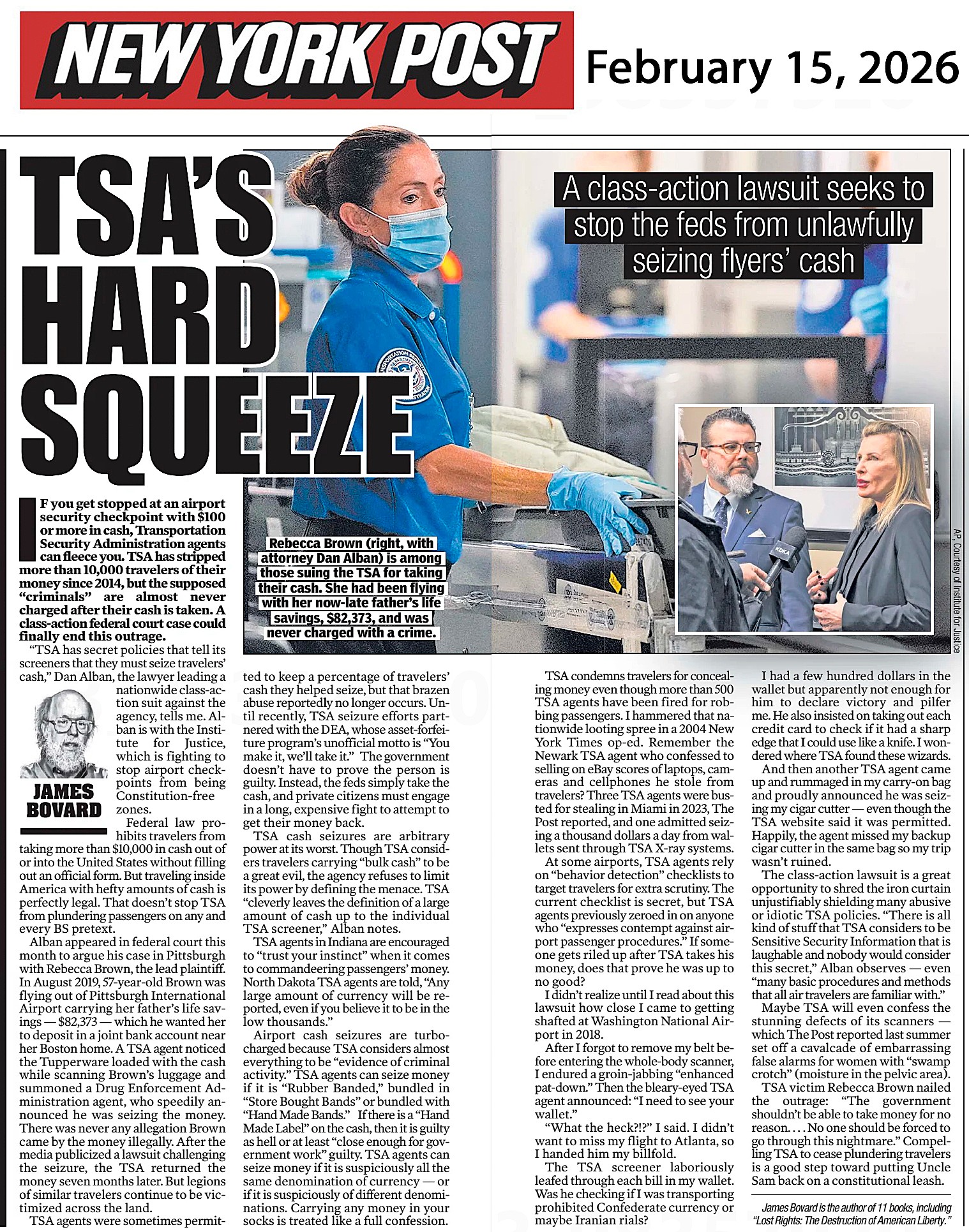
A class-action lawsuit seeks to stop TSA from unlawfully seizing flyers’ cash
by James Bovard
If you get stopped at an airport security checkpoint with $100 or more in cash, Transportation Security Administration agents can fleece you. TSA has stripped more than 10,000 travelers of their money since 2014, but the supposed “criminals” are almost never charged after their cash is taken. A class-action federal court case could finally end this outrage.
“TSA has secret policies that tell its screeners that they must seize travelers’ cash,” Dan Alban, the lawyer leading a nationwide class-action suit against the agency, tells me. Alban is with the Institute for Justice, which is fighting to stop airport checkpoints from being Constitution-free zones.
Federal law prohibits travelers from taking more than $10,000 in cash out of or into the United States without filling out an official form. But traveling inside America with hefty amounts of cash is perfectly legal. That doesn’t stop TSA from plundering passengers on any and every BS pretext.
Alban appeared in federal court this month to argue his case in Pittsburgh with Rebecca Brown, the lead plaintiff. In August 2019, 57-year-old Brown was flying out of Pittsburgh International Airport carrying her father’s life savings — $82,373 — which he wanted her to deposit in a joint bank account near her Boston home. A TSA agent noticed the Tupperware loaded with the cash while scanning Brown’s luggage and summoned a Drug Enforcement Administration agent, who speedily announced he was seizing the money. There was never any allegation Brown came by the money illegally. After the media publicized a lawsuit challenging the seizure, the TSA returned the money seven months later. But legions of similar travelers continue to be victimized across the land.
TSA agents were sometimes permitted to keep a percentage of travelers’ cash they helped seize, but that brazen abuse reportedly no longer occurs. Until recently, TSA seizure efforts partnered with the Drug Enforcement Agency, whose asset-forfeiture program’s unofficial motto is “You make it, we’ll take it.” The government doesn’t have to prove the person is guilty. Instead, the feds simply take the cash, and private citizens must engage in a long, expensive fight to attempt to get their money back.
TSA cash seizures are arbitrary power at its worst. Though TSA considers travelers carrying “bulk cash” to be a great evil, the agency refuses to limit its power by defining the menace. TSA “cleverly leaves the definition of a large amount of cash up to the individual TSA screener,” Alban notes.
TSA agents in Indiana are encouraged to “trust your instinct” when it comes to commandeering passengers’ money. North Dakota TSA agents are told, “Any large amount of currency will be reported, even if you believe it to be in the low thousands.”
Airport cash seizures are turbocharged because TSA considers almost everything to be “evidence of criminal activity.” TSA agents can seize money if it is “Rubber Banded,” bundled in “Store Bought Bands” or bundled with “Hand Made Bands.” If there is a “Hand Made Label” on the cash, then it is guilty as hell or at least “close enough for government work” guilty. TSA agents can seize money if it is suspiciously all the same denomination of currency — or if it is suspiciously of different denominations. Carrying any money in your socks is treated like a full confession.
TSA condemns travelers for concealing money even though more than 500 TSA agents have been fired for robbing passengers. I hammered that nationwide looting spree in a 2004 New York Times op-ed. Remember the Newark TSA agent who confessed to selling on eBay scores of laptops, cameras and cellphones he stole from travelers? Three TSA agents were busted for stealing in Miami in 2023, The Post reported, and one admitted seizing a thousand dollars a day from wallets sent through TSA X-ray systems.
At some airports, TSA agents rely on “behavior detection” checklists to target travelers for extra scrutiny. The current checklist is secret, but TSA agents previously zeroed in on anyone who “expresses contempt against airport passenger procedures.” If someone gets riled up after TSA takes his money, does that prove he was up to no good?
I didn’t realize until I read about this lawsuit how close I came to getting shafted at Washington National Airport in 2018.
After I forgot to remove my belt before entering the whole-body scanner, I endured a groin-jabbing “enhanced patdown.” Then the bleary-eyed TSA agent announced: “I need to see your wallet.”
“What the heck?!?” I said. I didn’t want to miss my flight to Atlanta, so I handed him my billfold.
The TSA screener laboriously leafed through each bill in my wallet. Was he checking if I was transporting prohibited Confederate currency or maybe Iranian rials?
I had a few hundred dollars in the wallet but apparently not enough for him to declare victory and pilfer me. He also insisted on taking out each credit card to check if it had a sharp edge that I could use like a knife. I wondered where TSA found these wizards.
And then another TSA agent came up and rummaged in my carry-on bag and proudly announced he was seizing my cigar cutter — even though the TSA website said it was permitted. Happily, the agent missed my backup cigar cutter in the same bag so my trip wasn’t ruined.
The class-action lawsuit is a great opportunity to shred the iron curtain unjustifiably shielding many abusive or idiotic TSA policies. “There is all kind of stuff that TSA considers to be Sensitive Security Information that is laughable and nobody would consider this secret,” Alban observes — even “many basic procedures and methods that all air travelers are familiar with.”
Maybe TSA will even confess the stunning defects of its scanners — which The Post reported last summer set off a cavalcade of embarrassing false alarms for women with “swamp crotch” (moisture in the pelvic area).
TSA victim Rebecca Brown nailed the outrage: “The government shouldn’t be able to take money for no reason. . . . No one should be forced to go through this nightmare.” Compelling TSA to cease plundering travelers is a good step toward putting Uncle Sam back on a constitutional leash.
James Bovard is the author of 11 books, including “Lost Rights: The Destruction of American Liberty.”



Comments are closed.