
While Elon Musk is being criticized for his role in slashing the budget of the U.S. Agency for International Development (AID), our foreign aid programs have been killing people for more than 50 years. American food aid has sabotaged foreign farmers since the 1960s, causing waves of bankruptcies and subverting foreign nations’ ability to feed themselves. I have been hammering this program since 1984. Here’s a piece I wrote on how U.S. food aid bankrupts foreign farmers for the Wall Street Journal back in the Reagan era. The article concluded: “If this is our humanitarianism, God help the Third World if we ever decide to get rough with them.” In 1985, when I interviewed AID chief Peter McPherson, my questions enraged him and he started shouting and threw me out of his office.
In 2013, I wrote a Wall Street Journal piece on how U.S. food “aid consistently wreaks havoc abroad. The Obama administration is pushing reforms that could slightly reduce the number of Third World farmers bushwhacked by American food dumped into their marketplaces.” But the Obama “fixes” were pitifully tepid.
In 2016, I wrote a Wall Street Journal piece bashing the Obama administration’s decision to dump a million pounds of surplus peanuts on Haiti, ravaging that nation’s poor farmers.
Here’s a screenshot of the 1984 piece. The text of the article is below the image.
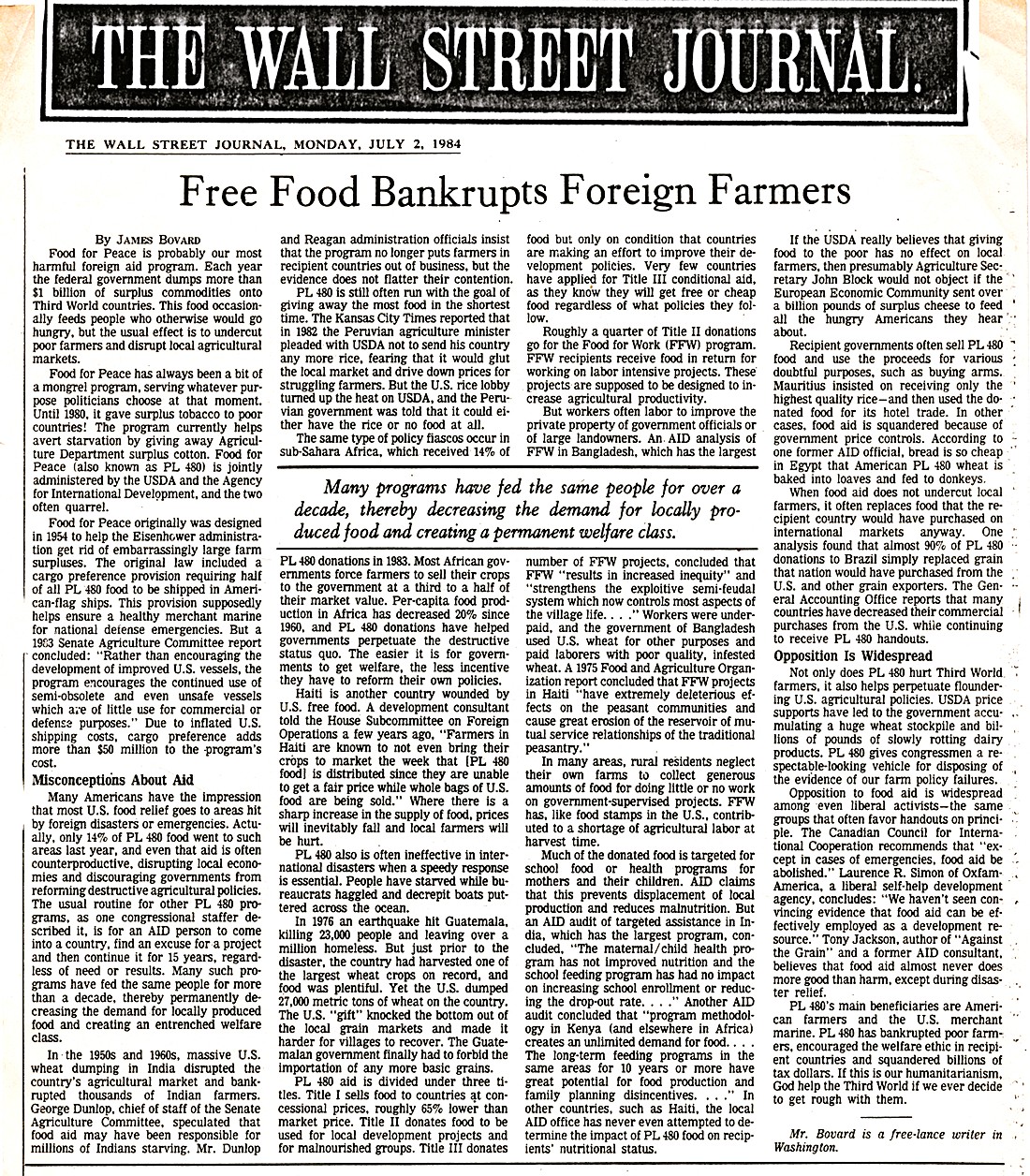
The Wall Street Journal, July 2, 1984
Free Food Bankrupts Foreign Farmers
By James Bovard
Food for Peace is probably our most harmful foreign aid
program. Each year the federal government dumps more than $1
billion of surplus commodities onto Third World countries.
This food occasionally feeds people who otherwise would go
hungry, but the usual effect is to undercut poor farmers and
disrupt local agricultural markets.
Food for Peace has always been a bit of a mongrel program,
serving whatever purpose politicians choose at that moment.
Until 1980, it gave surplus tobacco to poor countries! The
program currently helps avert starvation by giving away
Agriculture Department surplus cotton. Food for Peace (also
known as PL 480) is jointly administered by the USDA and the
Agency for International Development, and the two often
quarrel.
Food for Peace originally was designed in 1954 to help the
Eisenhower administration get rid of embarrassingly large
farm surpluses. The original law included a cargo preference
provision requiring half of all PL 480 food to be shipped in
American-flag ships. This provision supposedly helps ensure a
healthy merchant marine for national defense emergencies. But
a 1983 Senate Agriculture Committee report concluded: “Rather
than encouraging the development of improved U.S. vessels,
the program encourages the continued use of semi-obsolete and
even unsafe vessels which are of little use for commercial or
defense purposes.” Due to inflated U.S. shipping costs, cargo
preference adds more than $50 million to the program’s cost.
Many Americans have the impression that most U.S. food
relief goes to areas hit by foreign disasters or emergencies.
Actually, only 14% of PL 480 food went to such areas last
year, and even that aid is often counterproductive,
disrupting local economies and discouraging governments from
reforming destructive agricultural policies. The usual
routine for other PL 480 programs, as one congressional
staffer described it, is for an AID person to come into a
country, find an excuse for a project and then continue it
for 15 years, regardless of need or results. Many such
programs have fed the same people for more than a decade,
thereby permanently decreasing the demand for locally
produced food and creating an entrenched welfare class.
In the 1950s and 1960s, massive U.S. wheat dumping in
India disrupted the country’s agricultural market and
bankrupted thousands of Indian farmers. George Dunlop, chief
of staff of the Senate Agriculture Committee, speculated that
food aid may have been responsible for millions of Indians
starving. Mr. Dunlop and Reagan administration officials
insist that the program no longer puts farmers in recipient
countries out of business, but the evidence does not flatter
their contention.
PL 480 is still often run with the goal of giving away the
most food in the shortest time. The Kansas City Times
reported that in 1982 the Peruvian agriculture minister
pleaded with USDA not to send his country any more rice,
fearing that it would glut the local market and drive down
prices for struggling farmers. But the U.S. rice lobby turned
up the heat on USDA, and the Peruvian government was told
that it could either have the rice or no food at all.
The same type of policy fiascos occur in sub-Sahara
Africa, which received 14% of PL 480 donations in 1983. Most
African governments force farmers to sell their crops to the
government at a third to a half of their market value.
Per-capita food production in Africa has decreased 20% since
1960, and PL 480 donations have helped governments perpetuate
the destructive status quo. The easier it is for governments
to get welfare, the less incentive they have to reform their
own policies.
Haiti is another country wounded by U.S. free food. A
development consultant told the House Subcommittee on Foreign
Operations a few years ago, “Farmers in Haiti are known to
not even bring their crops to market the week that [PL 480
food] is distributed since they are unable to get a fair
price while whole bags of U.S. food are being sold.” Where
there is a sharp increase in the supply of food, prices will
inevitably fall and local farmers will be hurt.
PL 480 also is often ineffective in international
disasters when a speedy response is essential. People have
starved while bureaucrats haggled and decrepit boats puttered
across the ocean.
In 1976 an earthquake hit Guatemala, killing 23,000 people
and leaving over a million homeless. But just prior to the
disaster, the country had harvested one of the largest wheat
crops on record, and food was plentiful. Yet the U.S. dumped
27,000 metric tons of wheat on the country. The U.S. “gift”
knocked the bottom out of the local grain markets and made it
harder for villages to recover. The Guatemalan government
finally had to forbid the importation of any more basic
grains.
PL 480 aid is divided under three titles. Title I sells
food to countries at concessional prices, roughly 65% lower
than market price. Title II donates food to be used for local
development projects and for malnourished groups. Title III
donates food but only on condition that countries are making
an effort to improve their development policies. Very few
countries have applied for Title III conditional aid, as they
know they will get free or cheap food regardless of what
policies they follow.
Roughly a quarter of Title II donations go for the Food
for Work (FFW) program. FFW recipients receive food in return
for working on labor intensive projects. These projects are
supposed to be designed to increase agricultural
productivity.
But workers often labor to improve the private property of
government officials or of large landowners. An AID analysis
of FFW in Bangladesh, which has the largest number of FFW
projects, concluded that FFW “results in increased inequity”
and “strengthens the exploitive semi-feudal system which now
controls most aspects of the village life. . . .” Workers
were underpaid, and the government of Bangladesh used U.S.
wheat for other purposes and paid laborers with poor quality,
infested wheat. A 1975 Food and Agriculture Organization
report concluded that FFW projects in Haiti “have extremely
deleterious effects on the peasant communities and cause
great erosion of the reservoir of mutual service
relationships of the traditional peasantry.”
In many areas, rural residents neglect their own farms to
collect generous amounts of food for doing little or no work
on government-supervised projects. FFW has, like food stamps
in the U.S., contributed to a shortage of agricultural labor
at harvest time.
Much of the donated food is targeted for school food or
health programs for mothers and their children. AID claims
that this prevents displacement of local production and
reduces malnutrition. But an AID audit of targeted assistance
in India, which has the largest program, concluded, “The
maternal/child health program has not improved nutrition and
the school feeding program has had no impact on increasing
school enrollment or reducing the drop-out rate. . . .”
Another AID audit concluded that “program methodology in
Kenya (and elsewhere in Africa) creates an unlimited demand
for food. . . . The long-term feeding programs in the same
areas for 10 years or more have great potential for food
production and family planning disincentives. . . .” In other
countries, such as Haiti, the local AID office has never even
attempted to determine the impact of PL 480 food on
recipients’ nutritional status.
If the USDA really believes that giving food to the poor
has no effect on local farmers, then presumably Agriculture
Secretary John Block would not object if the European
Economic Community sent over a billion pounds of surplus
cheese to feed all the hungry Americans they hear about.
Recipient governments often sell PL 480 food and use the
proceeds for various doubtful purposes, such as buying arms.
Mauritius insisted on receiving only the highest quality rice
— and then used the donated food for its hotel trade. In
other cases, food aid is squandered because of government
price controls. According to one former AID official, bread
is so cheap in Egypt that American PL 480 wheat is baked into
loaves and fed to donkeys.
When food aid does not undercut local farmers, it often
replaces food that the recipient country would have purchased
on international markets anyway. One analysis found that
almost 90% of PL 480 donations to Brazil simply replaced
grain that nation would have purchased from the U.S. and
other grain exporters. The General Accounting Office reports
that many countries have decreased their commercial purchases
from the U.S. while continuing to receive PL 480 handouts.
Not only does PL 480 hurt Third World farmers, it also
helps perpetuate floundering U.S. agricultural policies. USDA
price supports have led to the government accumulating a huge
wheat stockpile and billions of pounds of slowly rotting
dairy products. PL 480 gives congressmen a
respectable-looking vehicle for disposing of the evidence of
our farm policy failures.
Opposition to food aid is widespread among even liberal
activists — the same groups that often favor handouts on
principle. The Canadian Council for International Cooperation
recommends that “except in cases of emergencies, food aid be
abolished.” Laurence R. Simon of OxfamAmerica, a liberal
self-help development agency, concludes: “We haven’t seen
convincing evidence that food aid can be effectively employed
as a development resource.” Tony Jackson, author of “Against
the Grain” and a former AID consultant, believes that food
aid almost never does more good than harm, except during
disaster relief.
PL 480’s main beneficiaries are American farmers and the
U.S. merchant marine. PL 480 has bankrupted poor farmers,
encouraged the welfare ethic in recipient countries and
squandered billions of tax dollars. If this is our
humanitarianism, God help the Third World if we ever decide
to get rough with them.
.
TAGLINE: Mr. Bovard is a free-lance writer in Washington.
Wall Street Journal April 30, 2013
How ‘Food for Peace’ Hurts Foreign Farmers
For a half-century the program has done more to feed special interests than help the hungry.
By JAMES BOVARD
The United States government is the world’s largest food donor but its aid consistently wreaks havoc abroad. The Obama administration is pushing reforms that could slightly reduce the number of Third World farmers bushwhacked by American food dumped into their marketplaces. But there is scant enthusiasm in Washington for any fix of a program that is beloved by many special interests.
The U.S. launched the Food for Peace program in 1954 during the Eisenhower administration, largely to dispose of embarrassing crop surpluses that had been encouraged by federal farm programs. To carry out Food for Peace, the U.S. Department of Agriculture buys crops grown by American farmers, has the food processed or bagged by U.S. companies, and then pays to send them overseas in U.S.-flagged ships. The annual cost to taxpayers? Last year, it was roughly $1.5 billion.
At least 25% of all U.S. food aid must be shipped from Great Lakes ports, per congressional mandate. This provides a steady stream of (taxpayer) revenue for American port towns and merchant seamen. Once the goods arrive at their destination, the U.S. Agency for International Development often takes charge or bestows the food on private relief organizations.
Because Food for Peace is structured to focus primarily on U.S. interests, it has long been notorious for putting some of the world’s poorest farmers out of business. Sen. Harry Bellmon (R., Okla.) crafted a legislative amendment in 1977 that required USAID and the Department of Agriculture to certify that food aid would not devastate farmers or destabilize markets in recipient countries. But whom does Uncle Sam entrust to assure that donations won’t pummel local farmers? In most cases, a foreign government or private-relief organization hoping to gain a tremendous free-food windfall from Washington.
To USAID’s credit, in 2008 it began tapping an independent consulting firm, Fintrac Inc., to recommend prudent donation levels. Nevertheless, in 2010 USAID approved sending almost three times as much rice to Liberia as Fintrac recommended. That same year the agency approved massive wheat shipments for Burundi and Sierra Leone, even though Fintrac recommended against it.
The Department of Agriculture is even more reckless. In 2008, it approved sending 30 times more soybean meal to Armenia than the agency’s own staff experts recommended.
Since 1985, USAID has permitted recipients to “monetize” U.S. food aid—selling all or part of it in local markets and using the proceeds to bankroll their preferred projects. U.S.-donated food is routinely sold in local markets for much less than prevailing prices. In 2002-03, a deluge of food aid in Malawi caused local corn prices to plunge by 60%. Mozambique wheat prices nose-dived in 2002 after USAID and the Department of Agriculture simultaneously “flooded the market,” according to the U.S. Government Accountability Office. Haitian farmers were similarly whipsawed after the U.S. and other nations bombarded the island with free food after the 2010 earthquake there.
In a speech this month at the Washington-based Center for Strategic and International Studies, Rajiv Shah, head of USAID since Dec. 31, 2009, called the monetization of food aid “inefficient and sometimes counterproductive,” saying that in some cases “evidence has indicated that this practice actually hurts the communities we seek to help.” Meanwhile, the United Nations Food and Agriculture Organization cautions that monetization often results in “destroying local farm prices” and CARE, one of the world’s largest relief organizations, boycotts all monetization projects.
The Obama administration is proposing to end monetization and instead give more cash to foreign governments and private-relief organizations to buy and distribute food locally and finance preferred projects. The administration also advocates trimming the percentage of the Food for Peace program’s budget spent purchasing and transporting U.S. food to 55% from the current 75%.
Not surprisingly, the administration’s proposals are facing staunch opposition from the farm lobby, relief organizations addicted to manna from USAID, and the merchant-marine lobby.
Yet Mr. Shah says USAID estimates that the proposed reforms would allow U.S. aid to feed up to four million more people per year. The agency is also touting a new program to distribute debit cards to allow refugees and others to shop for meals at local stores—similar to how the food-stamp program operates domestically.
The goal should not be to maximize the number of foreigners eating out of the U.S. government’s hand. When an impoverished foreign nation is struck by an unforeseen disaster, a temporary burst of food aid—public or private—can effectively save lives.
But in recent decades, the definition of “emergency” has been stretched to provide long-term feeding for people who are hungry largely due to their own government’s abuses. Most emergency food aid funding is actually spent on multiyear feeding programs that foster dependence and can produce epidemics of scurvy and beriberi because of grain-heavy diets.
The resistance that the Obama administration’s modest reforms are facing epitomizes how Congress and special interests don’t care how much harm food aid does abroad. Unfortunately, gross negligence has long been Food for Peace’s trademark.
Tagline: Mr. Bovard, a former World Bank consultant, is the author, most recently, of an e-book memoir, “Public Policy Hooligan.”
Wall Street Journal, May 26, 2016
A Subsidy as Shameful as They Come
By
James Bovard
The U.S. has paid for a million pounds of peanuts it can’t use. Solution: Dump them on Haiti—causing a disaster for its farmers.
The Obama administration’s plan to dump a million pounds of surplus peanuts into Haiti at no cost has sparked a firestorm from humanitarian groups across the hemisphere. Sixty organizations have signed a letter to the Agriculture Department and the U.S. Agency for International Development warning that the donation “could potentially set off a series of devastating consequences.”
Haiti has about 150,000 peanut farmers. The industry is “a huge source of livelihood” for up to 500,000 people, Claire Gilbert of Grassroots International told NPR, “especially women, if you include the supply chains that process the peanuts.” One of the leaders of Haiti’s largest rural organization, the Peasant Movement of Papaye, denounced the peanut donation as “a plan of death” for the country’s farmers.
That may sound histrionic, but American aid has a sordid record. In 1979 a development consultant told a congressional committee: “Farmers in Haiti are known to not even bring their crops to market the week that [food aid] is distributed since they are unable to get a fair price while whole bags of U.S. food are being sold.”
In 1984, 10 people were killed in Haiti when government troops fired on crowds rioting to protest corruption in the U.S. food donation program.
Why couldn’t peanuts have a similar effect? “USDA has not done any market analysis in Haiti,” Raymond Offenheiser, the president of Oxfam America, recently wrote in the Hill newspaper, “to ensure that this project does not interfere with local markets and does not reduce the opportunities for Haitian peanut farmers to sell their crop.”
Haiti has become far more dependent on food aid than it was a few decades ago. After the 2010 earthquake, Haiti’s president, René Préval, pleaded with the U.S. to “stop sending food aid so that our economy can recover and create jobs.” Former President Bill Clinton publicly apologized the same year for the devastating impact of subsidized U.S. rice imports: “I have to live every day with the consequences of the lost capacity to produce a rice crop in Haiti to feed those people, because of what I did.”
The Agriculture Department claims that the peanuts won’t hurt Haitian farmers because they will be packaged in one-ounce bags that “are to be consumed at school only,” as a government press secretary told NPR. Will the U.S. post guards at school doors to prevent “leakage” (the spokesperson’s term) into Haitian markets? After all, Haiti is one of the most corrupt nations on earth and foreign aid is routinely pilfered. Some activists also fear that this million pounds of peanuts will prove to be only the first shipment.
The real culprit here are federal peanut programs with an almost 80-year record as one of Washington’s most flagrant boondoggles. Subsidies have encouraged farmers to overproduce and then dump surplus peanuts on the USDA, which winds up stuck with hundreds of millions of pounds.
That food has to go somewhere, and the department sees Haiti as the ticket. Food-aid policies have long been driven not by altruism, but by bureaucratic desperation to dispose of the evidence of failed farm policies.
When the U.S. peanut program was launched in the 1930s, the federal government gave favored farmers licenses to grow the legumes and outlawed anyone else from planting them. Investors wound up purchasing many of the licenses and renting them back to growers. Congress ended the peanut licensing scheme in 2002 with a $4 billion buyout that provided a windfall to license-holders.
Lawmakers should have admitted then that there was no more justification for subsidizing peanuts than for propping up cashews or pecans, two crops that have thrived without handouts.
Instead, Congress created a new peanut program and effectively permitted a grower to collect twice as much in federal subsidies as other farmers ($125,000 for peanuts and another $125,000 for other crops). The 2014 farm bill guaranteed peanut farmers high prices, which is why they boosted production by more than 20% last year, even as the value per pound has plunged.
The cost of peanut subsidies is predicted to rise 10-fold between 2015 and next year, reaching $870 million—which approaches the total farm value of the whole U.S. peanut crop itself. The USDA expects to spend up to $50 million a year to store and handle surplus peanuts, and industry experts are warning that federally-licensed warehouses might not have enough space to hold the next crop.
The Haiti hubbub is simply the latest episode in a long history of peanut insanity in Washington. As long as congressmen can reap votes and campaign contributions from wrecking markets here and abroad, American goober policy will continue to be totally nuts.
Mr. Bovard is the author of “Attention Deficit Democracy” ( Palgrave Macmillan, 2006).
That 1984 piece spurred hostile letters to the editor:
Here are a few hostile Letters to the Editor:
7/27/84 Wall St. J. (Page Number Unavailable Online)
1984 WL-WSJ 223965
The Wall Street Journal
Copyright (c) 1984, Dow Jones & Co., Inc.
Friday, July 27, 1984
Letters to the Editor: Does Food for Peace Stunt Growth?
James Bovard’s “Free Food Bankrupts Foreign Farmers”
(editorial page, July 2) contains misconceptions regarding
the Public Law 480 Food for Peace Program.
PL 480 does not, as Mr. Bovard asserts, “undercut poor
farmers and disrupt local agricultural markets.” When the
program was initiated in 1954, recipients included Germany,
France, Italy, Poland, Yugoslavia, Greece, Spain and Norway.
The program did not destroy their agricultural economies and
the will to grow food. In fact, several of these countries
now contribute food through the EEC for similar programs.
Also, a study by Dr. H.W. Singer of the University of Sussex
found that in India — long the largest recipient of food aid
— “theoretical analysis gives no proof that food aid, if
properly handled, has serious disincentive effects on food
production.”
India illustrates the effectiveness of food for work
programs. In 1976 CARE introduced FFW projects there. These
mostly involved soil conservation, flood protection,
irrigation and school construction. Initially 235,000
recipients in hundreds of projects consumed 71,000 tons of PL
480 wheat. This program continued through 1979 and in its
peak year, 1977, had 1,180,000 recipients in food for work
activities that resulted in the distribution of 297,000 tons
of wheat. CARE was able to end its participation when two
very successful crop years made it possible for the
Government of India to take over the program with its own
resources. CARE’s food for work programs have now been made a
regular part of the Sixth Five-Year Plan. It is expected to
generate 300 million to 400 million mandays of work annually.
Mr. Bovard said that the U.S. Agency for International
Development in Haiti “has never attempted to determine the
impact of PL 480 food on recipients’ nutritional status.”
Actually such a study is being conducted by Joel Cotton for
AID and the first phase has been completed.
Contrary to Mr. Bovard’s assertion, a study by Prof.
Frederick Bates of the University of Georgia showed that
there was, indeed, a food shortage associated with the
earthquake in Guatemala in 1976. Also, instead of grain
prices dropping at the time, as Mr. Bovard claimed, prices
increased. The Bates study was far more comprehensive and
rigorous than the impressionistic Jackson piece cited later
in the article by Mr. Bovard.
Also, far from having food “dumped” on it, India today
purchases food when needed in the international commercial
market and is increasingly supplying its maternal/child
health program and midday meal program from its own
resources. The government is scheduled to take over this
program completely within 10 years.
Philip Johnston
Executive Director
CARE
New York
—
Public Law 480 embodies humanitarian, development, export
promotion, and foreign policy objectives. These objectives
have been and are being met.
Under Title I, contrary to Mr. Bovard’s understanding, the
U.S. provides long-term (20-40 years) credit at concessional
interest rates (2% to 4%) to facilitate purchases of U.S.
agricultural output at market prices by friendly developing
countries. The food is sold locally, with the proceeds used
to fund economic development. Since Title I generates local
(often non-convertible) currencies, it is difficult to see
how, without taking the notion of fungibility to absurd
lengths, Mr. Bovard imagines these monies being used by
governments to buy arms.
As to food production disincentives, the law requires the
Secretary of Agriculture to determine that distribution “will
not result in a substantial disincentive to or interference
with domestic production or marketing. . . .” Title I
agreements contain a series of “self-help measures,” tailored
to the situation of the recipient country, which spell out
specific actions to be taken to foster economic development.
These measures are not always easy or painless; they often
encourage price decontrol, market reliance, added attention
and resources to the private agriculture sector, and
elimination of consumer subsidies.
Title I is highly prized by food-deficit developing
countries that lack the foreign exchange to meet food needs
through normal commercial imports. The food deficit might be
chronic and self-reliance might be a generation away, even
with the proper help. In other cases, a normally self-reliant
country may need short-term help to deal with a natural or
man-made disaster.
Title II donates food to the world’s neediest. Even here,
though, every effort is made to maximize the contribution to
development of this humanitarian program.
Title III is similar to Title I, except that it calls for
added policy reform or other developmental progress in
exchange for a multi-year food aid commitment and forgiveness
of the food-aid debt. Since the enactment of Title III,
however, Title I’s economic development conditions were
toughened, and the difference between the developmental
impact of the two Titles has lessened markedly.
Mr. Bovard suggests that U.S. food aid has hampered
agricultural production overseas, and that somehow, without
food aid, countries would be motivated to produce more
domestically. The fact is that a real hunger problem exists
in the world today, which even Mr. Bovard cannot wish away.
Food aid has not prevented the dramatic increase in food
production in the developing world over the past few decades.
Population, unfortunately, has increased even faster.
Developing countries’ import needs (commercial purchases plus
food aid) total about 95 million tons per year. The U.S.
sells about 40 million tons to the developing world, and
provides somewhat over five million tons in food aid. It is
hard to argue that the five million tons is a significant
disincentive to domestic production.
Denis Lamb
Deputy Assistant Secretary
Trade and Commercial Affairs
State Department
Washington



No comments yet.