
On this day in 1978, my first op-ed appeared in a major newspaper. The Boston Globe published my attack on the Postal Service with a kick-ass headline that made even me smile: “Time to Stamp Out the Postal Monopoly.”
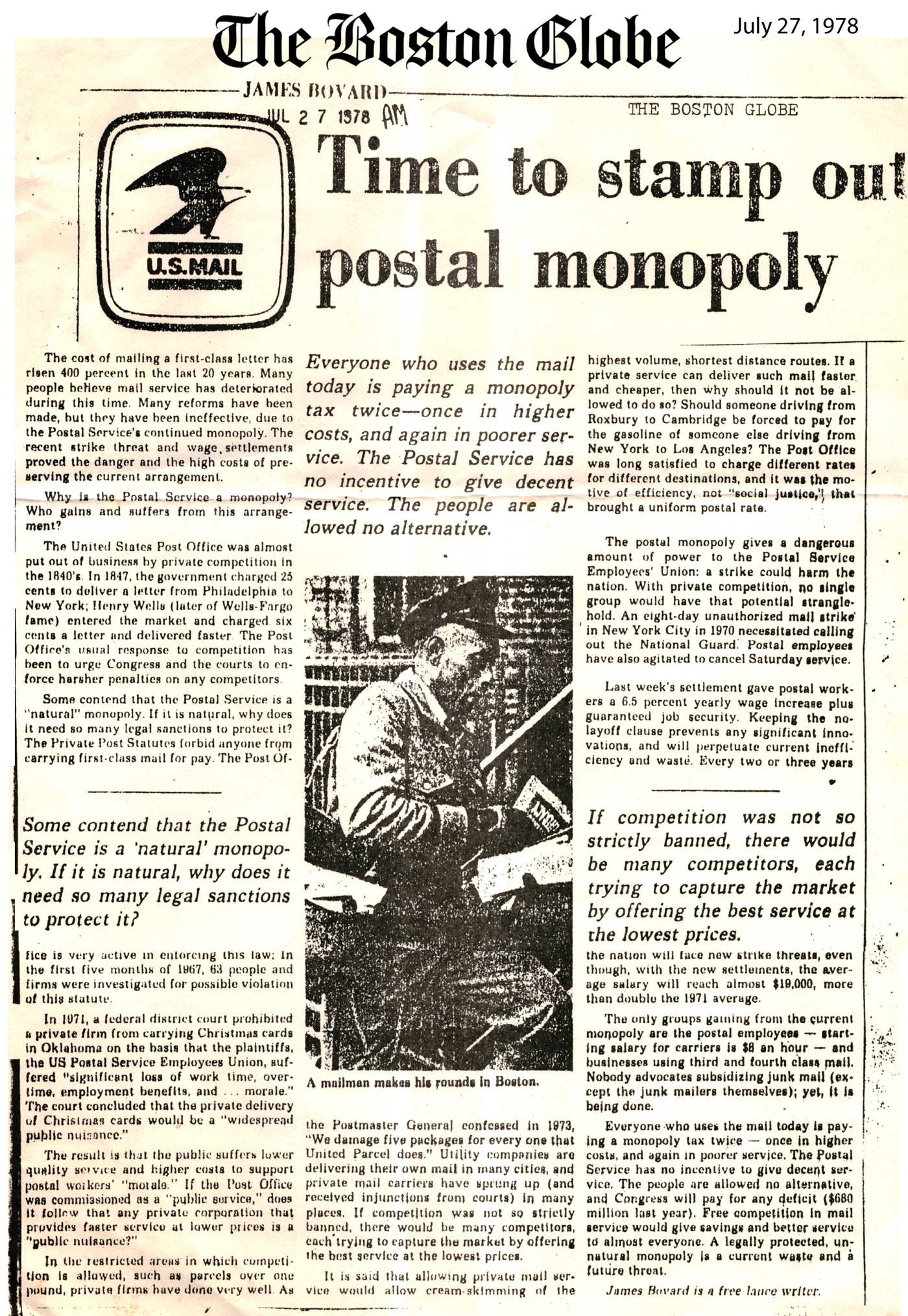
Looking at the recent scanned image, I suspect the years have been hard on that photocopy sent to me by a Boston Globe editor back during the Jimmy Carter era. I am reposting the text of that article below this next repost –
Here’s my 2018 Mises Institute piece, ”
40 Years of Pummeling the Postal Service

Today is the 40th anniversary of the publication of my first attack on the Postal Service. “Time to Stamp Out the Postal Monopoly” was the lead article on the Boston Globe oped page . A dozen years later, the chief postmaster of Boston denounced me as “the nation’s number one postal basher.”
I forgot to thank the postal unions for clinching the 1978 sale of that piece – my first in a major paper. I had pitched the piece to the Globe a couple months earlier and revised it to their specifications. But then I heard nothing and I assumed the piece was dead. Then the postal unions threatened a nationwide strike, kindly providing a newspeg (and perhaps also enraging some Globe editors). The Carter administration placated the unions with hefty raises and guaranteed lifetime jobs.
Back in those days, the U.S. mail was practically the only way an aspiring writer could afflict editors in distant cities with his work. Stamp prices were skyrocketing and service was wildly erratic, delaying the arrival of vital reject slips. Mail delivery ceased entirely for a week after the postman became frightened of the Dobermans owned by the drug dealers on the ground floor of the rickety apartment building where I lived. To visit a Boston post office was to descend into a netherworld of zombies and psychopaths who hated anyone who approached them with an unstamped envelope. The worst outrage was that it was a federal crime for anyone else to provide better mail service.
The next year, I whacked the Postal Service in the Washington Star and followed up, after I moved to the Midwest, with a hit in the Chicago Tribune in 1980. That piece led to my first talk show – an appearance on Chicago’s WVON radio station. It did not occur to me that I should be conversational instead of responding warily, like I was being cross-examined late at night at a police road block. The talk show host utterly misunderstood the article and her questions seemed inane. When I asked her to clarify, she repeated her lines louder. I was unaware that interview questions are often written by an assistant or an intern. For a talk show host to read an entire 700-word article is like a normal person reading Moby Dick.
After I moved to Washington, I often visited the lavish new headquarters of the Postal Service – thanks to their top floor library with panoramic views and a nook where stogies could be puffed all day. Old histories and dog-eared reports proved that the Post Office had been warring against its competitors ever since Congress gave it a monopoly over letter delivery prior to the Civil War. I burst out laughing when I to read the Post Office’s 1960 annual report’s proclamation of “the ultimate objective of next-day delivery of first-class mail anywhere in the United States.”
I smacked the Postal Service in publications ranging from Inquiry to the Los Angeles Herald Examiner to the Washington Times. Beginning in 1984, I regularly slammed the Postal Service in the Wall Street Journal, whose editorial features editor Tim Ferguson was the best and stoutest libertarian-leaning editor I encountered at a major outlet. I hammered the theme that “mail service is becoming slower, more expensive and less reliable.” I also pointed out how the Postal Service’s delivery tests – endlessly touted in their advertisements – were utterly fraudulent.
Every time the Postal Service raised postage rates or slashed service, I gave them another wallop. In a 1987 New York Times op-ed, I wrote that “First-class mail is becoming the ghetto of American communications… The U.S. cannot afford to enter the next century with a communications system little changed from the 18th century.” Assistant Postmaster General Frank Johnson responded that “Bovard continues to play his fanciful intellectual demolition derby… He often allows his bandwagon to run amok, rolling over much that is good. Pedestrian facts end up flattened.” Earlier in 1987, Johnson complained to the Wall Street Journal that I was “the Pied Piper of Privatization.”
Mauling the mail service led to my first gig as a scarecrow. The National Association of Postmasters invited me to speak to their annual Washington conference so that members would have “a clear picture of the very real threats that are bombarding us daily,” the association’s chief, a grizzled Irish postmaster-politician from Massachusetts, declared. I ambled up to the lectern at 9 a.m. Five minutes later, I had all 300 audience members on their feet howling with homicidal intent.
I spoke about how government monopolies lacked incentives to provide good service and asked: “If you had to invest your life savings in one company – would you choose United Parcel Service or the Postal Service?” “We already invested our lives in the Postal Service!” came the thunderous response. Oops.
The Boss Postmaster repeatedly jumped on stage to simmer the audience down so I could finish. Afterwards, he unleashed a podium-pounding tirade that flailed my views up-and-down and strutted before his members as if he’d just slain an anti-postal dragon. I only wish I could pocket $500 every time I get heartily cussed.
In 1989, nudged by Tim Ferguson, I spent five months seeking an interview with Postmaster General Anthony Frank. But a Postal Service spokesman told me that since the Postmaster General had recently appeared on “The Pat Sajak Show,” he did not need exposure in the Wall Street Journal. Besides, the spokesman said, my previous postal articles had been “tainted with bias.” Though the Postal Service was losing $2 billion a year, Frank scorned fundamental reforms, claiming that privatization would be “the Wino and Derelict Full Employment Act…. A lot of [the private carriers] would only work until they get the price of a bottle of Ripple and then they’d quit.” I scoffed in a WSJ piece that “the American people no longer need a monopoly that appears more interested in storing letters than in delivering them.” In a reply to the Journal, Frank complained that the piece was “just another case of Mr. Bovard mixing facts with fancy to suit his own” agenda.
In a 1991 Wall Street Journal piece, I jibed that “the Postal Service is the only delivery business that believes speed is irrelevant” and said that a pending four-cent hike in stamp prices “will help finance the greatest intentional mail slowdown in U.S. history.”
After I smacked the postal monopoly in USA Today in 1995, the Postal Service’s “media relations” manager claimed it was “utter nonsense” that the Postal Service was intentionally slowing the mail and lamented: “We find it very frustrating when individuals with an agenda and a pen are given a forum to spread malicious misinformation.” Since then, the Postal Service has become far more forthright about its slowdowns – which never produce the savings anticipated. But since they have captive customers, why not abuse them?
The Postal Service has a long history as a tool of government surveillance and suppression. Writing in USA Today in 1999, I hammered the Postal Service’s crackdown on private mail boxes and touted corrective legislation championed by Rep. Ron Paul. That piece concluded that “the only real solution is to demilitarize the Postal Service’s legal arsenal and end its power over other businesses and American citizens.”
In 2011, after the Postal Service announced plans to largely abolish overnight mail delivery, I slammed them in the Los Angeles Times: “When people bought ‘forever’ stamps, they didn’t realize that the name referred to the delivery time, not stamp prices.” The Times published a letter from an angry postal fan who demanded to know: “Was James Bovard bit by a mailman as a child?”
In 2013, the Justice Department and Postal Service filed suit against Lance Armstrong’s bike racing team (which received $40 million from the Postal Service), claiming that Armstrong had conspired to defraud the feds by using illegal stimulants. I commented in the Washington Times that “that conspiracy charge sounded like a good summary of the Postal Service’s own public relations strategy.” Besides, it made “no sense to to bankroll a bicycle-racing team at the same time that postal employees were widely perceived as a bunch of slackers.”
At this point, the Postal Service is rapidly becoming little more than an income maintenance program for the 630,000 employees. The big question is which will reach zero first – mail delivery targets or the Postal Service’s actual performance. Either way, the Postal Service continues to provide some of the starkest and most comical reminders of the folly of relying on the government.
XXXXXXXX
Time to Stamp out Postal Monopoly
by James Bovard
The cost of mailing a first-class letter has risen 400 percent in the last 20 years. Many people believe mail service has deteriorated during this time. Many reforms have been made, but they have been ineffective, due to the Postal Service’s continued monopoly. The recent strike threat and wage settlements proved the danger and the high costs of preserving the current arrangement.
Why is the Postal Service a monopoly? Who gains and suffers from this arrangement?
The United States Post Office was almost put out of business by private competition in the 1840’s. In 1847, the government charged 25 cents to deliver a letter from Philadelphia to New York; Henry Wells (later of Wells-Fargo fame) entered the market and charged six cents a letter and delivered faster. The Post Office’s usual response to competition has been to urge Congress and the courts to enforce harsher penalties on any competitors.
Some contend that the Postal Service is a “natural” monopoly. If it is natural, why does it need so many legal sanctions to protect it? The private Post Statues forbid anyone from carrying first-class mail for pay. the Post Office is very active in enforcing this later: in the first five months of 1967, 63 people and firms were investigated for possible violation of this statute.
In 1971, a federal district court prohibited a private firm from carrying Christmas cards in Oklahoma on the basis that the plaintiffs, the U.S. Postal Service employees union, suffered “significant loss of work time, employment benefits, and… morale.” The court concluded that the private delivery of Christmas cards would be a “widespread public nuisance.”
The result is that the public suffers lower quality service and higher costs to support postal workers’ “morale.” If the Post Office was commissioned as a “public service,” does it follow that any private corporation that provides faster service at lower prices is a “public nuisance”?
In the restricted areas in which competition is allowed, such as parcels over one pounds, private firms have done very well. As the Postmaster General confessed in 1973, “We damage five packages for everyone one that United Parcel does.” Utility companies are delivering their own mail in many cities, and private mail carriers have sprung up (and received injunctions from courts) in many places, If competition was not so strictly banned, there would be many competitors, each trying to capture the market by offering the best service at the lowest prices.
It is said that allowing private mail service would allow cream-skimming of the highest-value, shortest distance routes. If a private service can deliver such mail faster and cheaper, then why should it not be allowed to do so? Should someone driving from Roxbury to Cambridge be forced to pay for the gasoline of someone else driving from New York to Los Angeles? The Post Office was long satisfied to charge different rates for different destinations, and it was the motive of efficiency, not “social justice,” that brought a uniform postal rate.
The postal monopoly gives a dangerous amount of power to the Postal Service Employees’ Union: A strike could harm the nation. With private competition, no single group would have that potential stranglehold. An eight-day unauthorized mail strike in New York City in 1970 necessitated calling out the National Guard. Postal employees have also agitated to cancel Saturday service.
Last week’s settlement gave postal workers a 6.5% yearly wage increase plus guaranteed job security. Keeping the no-layoff clause prevents any significant innovations, and will perpetuate current inefficiency and waste. Every two or three years, the nation will face new strike threats, even though, with the new settlement, the average salary will reach almost $19,000, more than double the 1971 average.
The only groups gaining from the current monopoly are the postal employees – starting salary for carriers is $8 an hour – and businesses using third and fourth class mail. Nobody advocates subsidizing junk mail (except the junk mailers); yet, it is being done.
Everyone who uses the mail today is paying a monopoly tax twice – once in higher costs, and again in poorer service. The Postal Service has no incentive to give decent service. The people are allowed no alterative, and Congress will pay for any deficit ($680 million last year). Free competition in mail service would give savings and better service to almost everyone. A legally protected, unnatural monopoly is a current waste and a future threat.



No comments yet.