
My 40 Year War on Psychiatry
by James Bovard, June 16, 2026
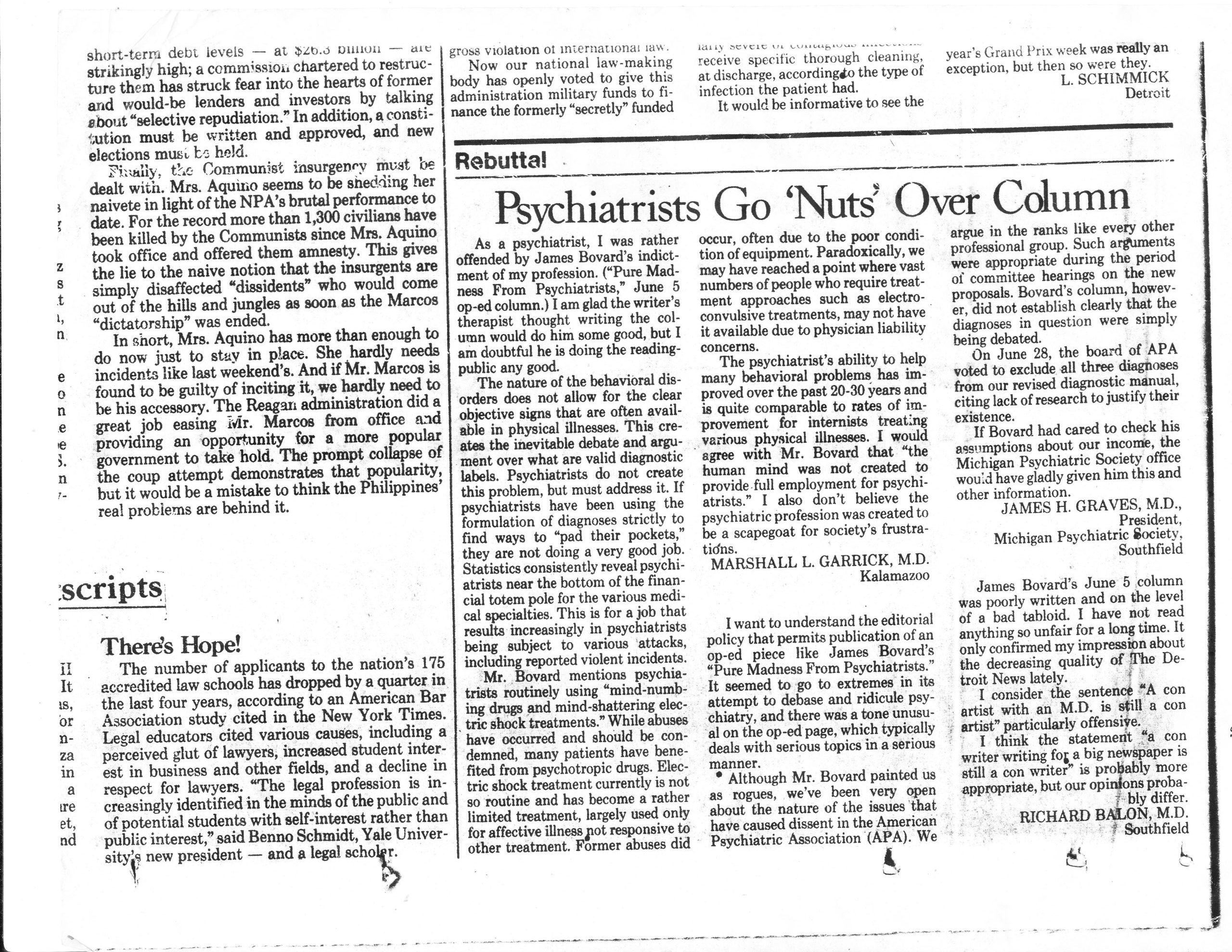
Forty years ago, I attended the annual meetings of the American Psychiatric Association in Washington and my sanity never recovered. Or at least that is what therapists presume based on my writings about their endless fabrication of bogus mental illnesses.
I was attending as a journalist to find grist for my weekly Detroit News column. That conference spurred zesty protests by Scientologists, feminists, and folks who never forgave the Electric Shock Therapy they endured.
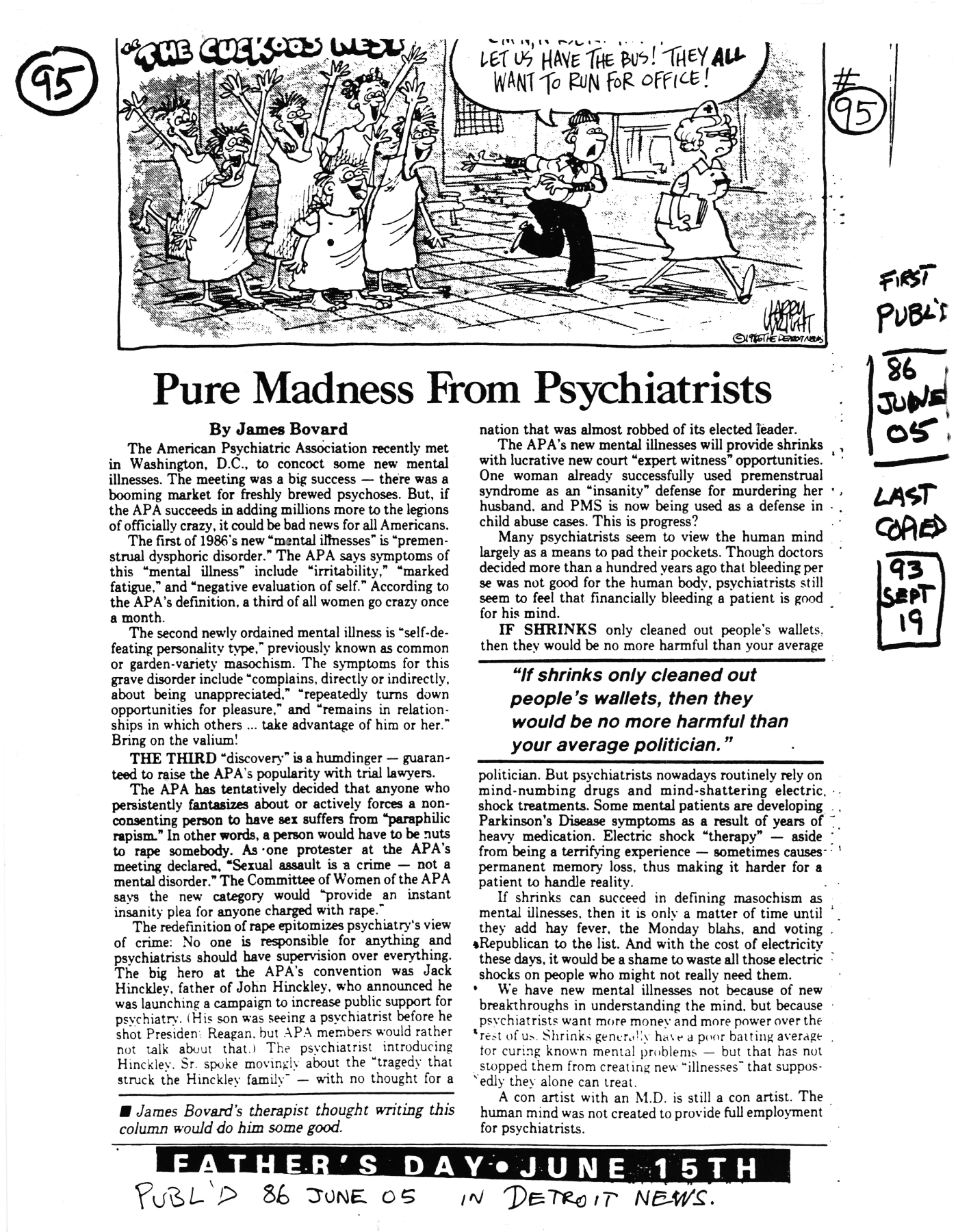
My “Pure Madness from Psychiatrists” op-ed, published on June 5, 1986, listed the latest proposed perfidious labels offered by therapists:
The first of 1986’s new “mental illness” is “premenstrual dysphoric disorder.” The APA says symptoms of this “mental illness” include “irritability,” “marked fatigue,” and “negative evaluation of self.” According to the APA’s definition, a third of all women go crazy once a month.
The second newly ordained mental illness is “self-defeating personality type,” previously known as common or garden-variety masochism. The symptoms for this grave disorder include “complaints, directly or indirectly, about being unappreciated,” “repeatedly turns down opportunities for pleasure,” and “remains in relationships in which others… take advantage of him or her.” Bring on the Valium!
The third “discovery” is a humdinger – guaranteed to raise the APA’s popularity with trial lawyers. The APA has tentatively decided that anyone who persistently fantasizes about or actively forces a non-consenting person to have sex suffers from “paraphilic rapism.” In other words, a person would have to be nuts to rape somebody. The Committee of Women of the APA said the new category would “provide an instant insanity plea for anyone charged with rape.” The redefinition of rape epitomizes psychiatry’s view of crime: no one is responsible for anything and psychiatrists should have supervision over everything.
The therapy business has gotten far wackier since then. Psychiatrists concocted labels that leave millions of Americans at their mercy.
The American Psychiatric Association’s Diagnostic and Statistical Manual of Mental Disorders (DSM) now lists more than three hundred mental illnesses, five times as many as it specified in the 1960s. Dr. Allen Frances, writing in Psychology Today, warned that the latest DSM contained “many changes that seem clearly unsafe and scientifically unsound” and is “likely to lead to massive over-diagnosis and harmful over-medication.” After the DSM redefined autism in the 1990s, the autism rate “quickly multiplied almost 100-fold.” That has spurred a deluge of squirrely Medicaid contractors and some of the worst federal frauds of the year.
Thanks to another DSM redefinition, the “number of American children and adolescents treated for bipolar disorder increased 40-fold” between 1993 and 2004, The New York Times reported. I met one of those unfortunate twenty-something designees when I was taking a smoke break outside a Maryland brewery a few years ago. She asked if I had any cigarettes; I offered her a cigar instead. I asked about the unusual tattoo on her wrist, and she said that was to memorialize the 18 people she knew who had died. She was as somber as the girl poet that Mark Twain memorialized in Huckleberry Finn.
She worked creating signs for a local company. She gravely confided that her life was difficult because she had been diagnosed as bipolar. I asked how her bipolar disorder manifested in her life.
“Some mornings, I just want to lie in bed and not go to work,” she replied.
Shizam, if I was making signs for parking spots, I might feel the same way. But this woman sounded like that diagnosis was a ball-and-chain she would drag behind her forever. University of Southern California clinical psychologist Darby Saxbe warns that mental-illness labels have “become an identity marker that makes people feel special and unique. . .telling them this is who they are and will be in the future.”
Psychiatrist Laurent Mottron complained in 2023 that the latest version of the DSM “is full of vague and trivial definitions and ambiguous language that ensures more people fall into various, abnormal categories.” Steven E. Hyman—the former director at the National Institute of Mental Health—warned in 2013 that the authors of the DSM
. . .chose a model in which all psychiatric illnesses were represented as categories discontinuous with “normal.” But this is totally wrong in a way they couldn’t have imagined. So in fact what they produced was an absolute scientific nightmare. Many people who get one diagnosis get five diagnoses, but they don’t have five diseases — they have one underlying condition.
A deluge of new mental illnesses is helping to hobble an entire young generation. Hungarian-American psychiatrist Thomas Szasz warned in the last century, “Psychiatrists manufacture mental diagnoses the way the Vatican manufactures saints.” The New York Times recently showcased psychiatric “prevalence inflation”—a vast increase in reported mental illness among teenagers because they are encouraged to view normal symptoms as grave maladies requiring intervention.
Psychiatrists have helped some individuals better understand themselves and deal more deftly with everyday reality. But bogus mental illnesses have turned millions of healthy Americans into “mental patients,” according to Dr. Allen Frances. That debacle explains why Thomas Szasz crusaded against the “therapeutic state” and the “medicalization of everyday life.”
Antidepressant prescriptions for Americans aged 12 to 25 soared by 66 percent between 2016 and 2022. Roughly one in six adults in America currently take medications for depression or anxiety. Secretary of Health and Human Services Robert F. Kennedy Jr. recently lamented antidepressants are more addictive than heroin.
The Americans with Disabilities Act can convert mental illnesses into an entitlement program. People with a mental illness diagnosis become entitled to demand “reasonable accommodation” from employers, schools, and other entities. Even before the pandemic, up to 25 percent of students at top colleges were “classified as disabled, largely because of mental-health issues such as depression or anxiety, entitling them to a widening array of special accommodations like longer time to take exams,” the Wall Street Journal reported in 2018. A Boston University analysis of students on almost 400 campuses in 2022 found that “60% of the respondents met the qualifying criteria for ‘one or more mental health problems, a nearly 50% increase from 2013.’”
Hooking people on bogus labels and antidepressants has already ruined too many American lives. Passing out millions more psychiatric Purple Hearts will not make this nation happier or more sane.



No comments yet.